Why Dental Implants Are the Standard of Care
If you’re missing one or more teeth, you already know it’s about more than just a gap in your smile. Chewing gets harder, speech can change, and the jawbone underneath the missing tooth actually starts to shrink over time. Dental implants are the only tooth-replacement option that addresses all three problems at once, which is why they’ve become the standard of care for missing teeth in modern dentistry.
At Holyoke Mall Dental, our dentists place dental implants for patients throughout Holyoke, MA, and the surrounding area. Below, we break down the real, evidence-backed benefits of dental implants and not just the marketing version so you can decide with confidence whether they’re right for you. Call our Holyoke dental practice at (413) 538-7400 to schedule a consultation.
What Is a Dental Implant, Exactly?
A dental implant is a small titanium post that a dentist places directly into the jawbone, where it functions as an artificial tooth root. Once the bone fuses to the titanium, a process called osseointegration, an abutment and a custom-matched crown are attached on top, completing a replacement tooth that looks and functions like the one you lost. Because implants replace both the root and the crown, they solve problems that dentures and bridges can’t.
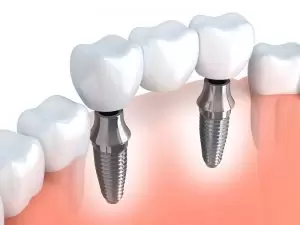
Top Benefits of Dental Implants
1. Prevents Bone Loss
Without stimulation from a tooth root, the underlying jawbone begins to resorb—shrinking and weakening over time. Left unaddressed, this can change your facial structure over time. A dental implant is the only replacement option that restores that stimulation, because the titanium post itself fuses with the bone and keeps it active.
2. Restores a Natural, Confident Smile
Missing teeth affect more than function. For a lot of patients, they affect how comfortable they feel smiling, speaking, or eating in front of other people. Implant crowns are custom-shaded and shaped to match your surrounding teeth, so the replacement blends in rather than standing out. Most patients tell us that once healing is complete, they simply forget which tooth was the implant.
3. Functions Like a Real Tooth
Because the implant is anchored in bone rather than resting on the gums like a denture, it restores close to full biting force. That means foods that used to be off-limits, such as apples, corn on the cob, and a good steak, are back on the menu without the shifting or discomfort that comes with removable appliances.
4. Simple to Maintain
An implant crown doesn’t require special cleaning solutions, soaking, or adhesives. You brush and floss it the same way you would a natural tooth, alongside regular checkups at your Holyoke, MA, dentist’s office. That’s it.
5. Built to Last
The titanium implant post itself is designed to last a lifetime once it’s fully integrated with the jawbone. The crown on top may need replacement after many years of normal wear, the same as a natural tooth’s enamel would, but the foundation underneath doesn’t.
6. Improves Speech
Ill-fitting dentures can slip inside the mouth, which affects how certain sounds and words come out. Because an implant is fixed in place rather than removable, it eliminates that slipping. This means clearer, more confident speech.
7. Protects Your Long-Term Oral Health
A gap left by a missing tooth doesn’t stay empty. Neighboring teeth can drift into the space, throwing off your bite and making those teeth harder to clean, which raises the risk of decay and gum disease around them. An implant fills the space and keeps the rest of your bite stable, without requiring your dentist to grind down healthy adjacent teeth for support (the way a traditional bridge does).
8. Secure and Non-Removable
There’s no adhesive, no clasp, and no slipping. Once healed, an implant-supported crown functions as a fixed part of your mouth. You can now eat, laugh, and speak without worrying about it moving.
9. Made From Biocompatible Titanium
Titanium is one of the most biocompatible materials used in medicine. It’s also used in joint replacements, which is why the body accepts it so readily and why rejection is rare. It’s also resistant to decay, so an implant itself can’t develop a cavity the way a natural tooth can.
10. A Long-Term Value
Because a well-maintained implant is designed to last decades, patients often find it’s a better long-term value than repeatedly repairing or replacing a bridge or denture over the same period, even though the upfront cost is higher.

Why Holyoke, MA Patients Choose Implants Over Dentures or Bridges
Dental implants aren’t the only way to replace a missing tooth. Dentures and bridges are still appropriate for some patients and situations. The difference comes down to what’s being replaced and how it’s supported:
- Dental bridges replace a tooth by anchoring a crown to the two adjacent teeth, which means those teeth have to be reshaped to support it.
- Dentures rest on the gums and can be removed, but they can also shift while eating or speaking.
- Dental implants replace the tooth and the root, standing on their own without altering neighboring teeth or resting loosely on the gums.
Your dentist can walk you through which option fits your specific case, including whether an implant-supported denture might be the right middle ground if you’re missing several teeth.
How Predictable Is Implant Dentistry, Really?
This is a legitimate question to ask before any surgical procedure. According to data cited by the American Association of Oral and Maxillofacial Surgeons and research published in the Journal of Oral Implantology, dental implants have a long-term success rate in the range of 95–98% for healthy patients—making them one of the most predictable procedures in modern dentistry. National health survey data also shows implant use among U.S. adults has climbed steadily over the past two decades, reflecting both improved technique and growing patient confidence in the procedure.
As with any surgery, there are risks to be aware of, including infection, delayed healing, or (rarely) implant failure. Your dentist will review your health history and jawbone density to confirm you’re a good candidate before moving forward.
Finding a Dentist Near You for Dental Implants
Holyoke Mall Dental provides implant dentistry for patients throughout Holyoke and the surrounding Western Massachusetts communities, including Springfield, Chicopee, Westfield, West Springfield, Agawam, Wilbraham, and South Hadley. If you’ve searched for a dentist near you who offers dental implants, our Holyoke, MA, office is easy to reach from anywhere in the Greater Springfield area, with flexible scheduling and financing options available for patients who need them.
Frequently Asked Questions
No referral is required for dental implants. You can schedule a dental implant consultation directly with our Holyoke, MA, office by calling (413) 538-7400 or booking online.
Cost varies based on how many teeth are being replaced and whether any preparatory treatment (like a bone graft) is needed. Our team will walk you through a personalized estimate and available financing during your consultation.
Dental implants do require a surgical procedure, and as with any surgery, there’s a small risk of complications such as infection, delayed healing, implant failure, or nerve involvement. For most healthy patients, these risks are low, and the long-term benefits outweigh them.
No. Titanium, the metal used in dental implants, is non-magnetic, so it’s very unlikely to trigger a metal detector.
No. Because implants are made of titanium rather than natural tooth enamel, they can’t develop cavities. You’ll still want to keep up with brushing, flossing, and regular checkups to protect the gum tissue and bone around the implant and to keep your natural teeth healthy.
Ready to Experience the Benefits of Dental Implants?
If you’re missing one or more teeth and want to know whether dental implants are right for you, our Holyoke, MA dental team is here to help. Contact us today at (413) 538-7400 to schedule your consultation, or learn more about implant maintenance to see what long-term care looks like.
We’re proud to provide restorative dentistry to patients throughout the Greater Springfield area, including Westfield, Southampton, South Hadley, and nearby Western Massachusetts communities.